An LED lighting catalog crosses four headings. The diode itself is 8541, a bulb with a screw base is 8539, a finished fixture is 9405 and the driver that powers it is 8504. From China those lines now pay anywhere from 14.5 to 45.5 percent, and the gap comes down to a single call: is this a lamp or a luminaire? This is a buyer's comparison of the software that classifies a whole lighting catalog, with the 2026 duty by line and what it costs per SKU.
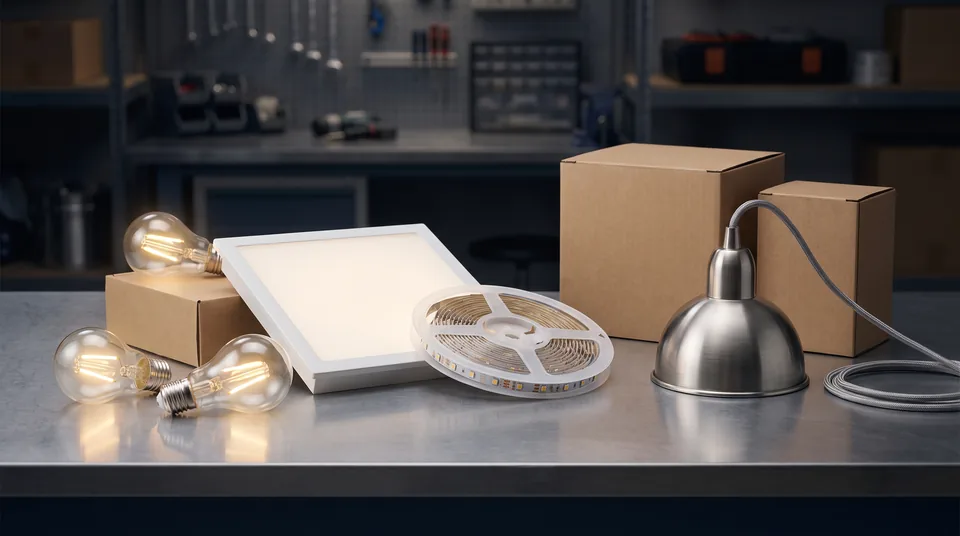
What is the best HS code classification software for LED lighting importers?
For a US lighting brand, distributor or contractor supply house importing LED bulbs, fixtures, strips and drivers, the best fit is a classifier that returns the full 10-digit HTSUS code from a plain product description, separates lamps from luminaires correctly, reads the housing material, and shows the 2026 duty by origin on the same screen. TariffWise does that from $59 a month, with bulk CSV classification of a whole catalog on the $199 Growth plan. Multi-country distributors may want an enterprise trade content suite, and a licensed customs broker is still the right call for contested lines and for filing the entry.
General lookups struggle with lighting because product names describe the job, not the construction. "High bay", "troffer", "puck light", "tape light" and "A19 replacement" do not tell the schedule whether the light source is built in, whether the housing is aluminum or plastic, or whether the item is a complete fitting or a part. Those three facts decide the code, and on a China-made fixture they swing the duty by up to 31 points.
Where LED products sit in the US tariff schedule
Rates below are the column 1 general rate and the China total, read from the 2026 HTSUS, Revision 20. The China total adds the original Section 301 list rate, where the line is on one, and the 12.5 percent layer under heading 9903.05.31 that took effect on July 24, 2026.
| Product | HTSUS line | General rate | From China in 2026 |
|---|---|---|---|
| Bare LEDs (the diode) | 8541.41.00.00 | Free | 37.5% (List 1 plus 12.5%) |
| LED modules | 8539.51.00.00 | Free | 37.5% (List 3 plus 12.5%) |
| LED lamps (bulbs and tubes with a cap) | 8539.52.00 | 2% | 14.5% (no active 301 list) |
| Ceiling or wall fitting for LED, base metal other than brass | 9405.11.60 | 7.6% | 45.1% (List 3 plus 12.5%) |
| Ceiling or wall fitting for LED, not of base metal | 9405.11.80 | 3.9% | 41.4% |
| Table, desk or floor lamp for LED, base metal other than brass | 9405.21.60 | 6% | 43.5% |
| LED string lights for Christmas trees | 9405.31.00 | 8% | 45.5% |
| Other LED fittings of base metal (flood, high bay, area lights) | 9405.42.60.00 | 6% | 43.5% |
| Other LED fittings and lighting sets, not base metal | 9405.42.84 | 3.9% | 41.4% |
| Illuminated signs for LED, base metal other than brass | 9405.61.40.00 | 6% | 43.5% |
| LED drivers and other power supplies | 8504.40.95 | Free | 37.5% (List 3 plus 12.5%) |
MPF, and HMF for ocean freight, come on top of every line. The list-by-list picture for other products is on the Section 301 tariff list by product page, and the landed cost calculator turns any of these into a per-unit cost.
Four calls that change what a lighting importer pays in 2026
1. Lamp or luminaire decides a 31-point swing
A replaceable LED bulb or tube with a cap is a lamp in 8539.52, at 2 percent, and from China it carries no active Section 301 list: its predecessor line, 8539.50.00, sat on List 4B, which was never put into effect. So the China total is 14.5 percent. The moment the light source is built into a housing that mounts, hangs or stands, it becomes a lighting fitting in 9405, and every 9405 line is on List 3. An integrated LED downlight at 9405.11.60 lands at 45.1 percent. A "retrofit kit", a "lamp" that is really a fixture, or a bulb shipped inside a fixture box is where most lighting catalogs go wrong.
2. The housing material sets the base rate
Inside 9405 the schedule splits by material: brass, other base metal, and everything else. For ceiling and wall fittings that means 3.9, 7.6 or 3.9 percent; for table and floor lamps 3.7, 6 or 3.9 percent. An aluminum-housed wall pack and a polycarbonate one are different lines. Your spec sheet needs the housing material per model, or the code is a guess, and CBP reviewers ask for exactly that fact. Aluminum lamppost bases, 9405.99.40.20, also sit on the Section 232 aluminum derivative list, which brings the metals rules into play.
3. Parts and components are not the fixture
A distributor selling replacement parts classifies each one on its own: bare LEDs in 8541.41, modules in 8539.51, drivers in 8504.40, and housings, lenses and other parts of fittings in 9405.91 to 9405.99. Each carries its own 301 list and base rate. The common shortcut, entering a mixed box of parts under the fixture's code, is wrong on most lines, and the driver line alone is a 37.5 percent item from China.
4. Origin now decides as much as the code
China carries the original 301 lists plus 12.5 percent. Vietnam and Thailand also pay 12.5 percent under the July 24 action, and Cambodia 10 percent, but they do not carry the China-only 301 lists, so a 9405.11.60 fitting from Vietnam is 20.1 percent instead of 45.1. Moving production is a real lever for this category, and it is also why the country of origin claim needs support: a fixture assembled in Vietnam from a Chinese kit may not change origin. Put who carries the duty and the origin paperwork into the supply agreement, and keep those terms somewhere your buyers can find them, with contract management software if you run more than a few factories.
What else rides on a lighting entry
Classification feeds the rest of the compliance review. LED lamps sold as general service lamps must meet the Department of Energy efficiency standards, and medium screw base lamps need the FTC Lighting Facts label under 16 CFR Part 305. LED drivers and lamps with electronics fall under FCC Part 15 rules on electromagnetic emissions. Retailers and electrical inspectors generally expect a safety listing to UL 8750 or the relevant luminaire standard. None of these change the HTS code, but a tool that records what each product is makes the rest of the file faster to assemble.
LED lighting classification tools compared
| Tool | Code depth | Shows why the code applies | Best for | Published pricing |
|---|---|---|---|---|
| TariffWise | 10-digit HTSUS with the 2026 duty stack by origin and landed cost | Yes, reasoning on every result plus runner-up codes | US lighting brands, distributors and supply houses classifying fixtures, lamps and parts before an order | $59, $199, $499 a month |
| Gaia Dynamics | HS and HTS, several countries | Yes, with ruling citations | Brands selling into several markets, yearly billing | $99, $379, $1,399 a month, billed yearly |
| Quickcode | HTS with rulings and notes beside it | Yes, research panel | Brokers and classifiers who read rulings first | Free for 10 a month, then from $749 a month |
| GingerControl | HTS with stacked duty | Yes, interactive questions | Importers that also want refund and audit services | No published rate card |
| Descartes CustomsInfo | Multi-country tariff content | Research library | Large teams classifying for many countries | Not published |
| Licensed customs broker | 10-digit on the entry | On request | Contested products and the entry itself | About $50 to $200 per product review |
The wider field is on the best HS code classification software roundup. Test any tool the same way: take ten products your team has argued about, including a bulb, an integrated downlight, an aluminum high bay, a tape light kit and a loose driver, and compare all ten digits and the stated reason. Lighting often ships alongside other electronics, and the electronic components importers comparison covers the 8541 and 8504 side in more depth.
How much does it cost to classify a lighting catalog?
| Catalog | Broker review at $50 to $200 each | TariffWise |
|---|---|---|
| 60 fixtures for a new product line | $3,000 to $12,000 | Starter, $59 for the month |
| 800 lamps, fixtures, strips and drivers | $40,000 to $160,000 | Growth, $199 for the month, one CSV run |
| A 6,000-line lighting and electrical distributor | Rarely quoted per line at this size | Business, $499 for the month |
Run the catalog as a CSV once, with a description, housing material and whether the light source is built in for each row. Read the reasoning on anything flagged and send the handful of contested items to your broker. Plans and seats are on the classification pricing page, and starting codes for other product families are on HS code lookup by product.
Questions LED lighting importers ask before choosing a tool
What is the HS code for LED lights?
It depends on what the product is. A replaceable LED bulb or tube with a cap is 8539.52, LED modules are 8539.51, and a complete LED light fitting such as a downlight, panel, flood or high bay is heading 9405, split by type and housing material. A bare diode is 8541.41, and an LED driver is usually 8504.40.
What is the import duty on LED lights from China?
In September 2026 an LED bulb from China pays 14.5 percent: 2 percent general plus the 12.5 percent layer from July 24, 2026. An LED fixture under heading 9405 pays its general rate of 3.9 to 8 percent, plus 25 percent under Section 301 List 3, plus 12.5 percent, which comes to 41.4 to 45.5 percent in total.
Are LED fixtures on the Section 301 list?
Yes. Every line in heading 9405, including LED fixtures, lamps and their parts, is on Section 301 List 3 at 25 percent for goods of China. LED modules (8539.51) and drivers (8504.40.95) are on List 3 too, and bare LEDs (8541.41) on List 1. LED lamps in 8539.52 are not on an active list.
What is the difference between 8539 and 9405 for LED products?
Heading 8539 covers light sources: LED lamps with a cap and LED modules that go into a fitting. Heading 9405 covers the complete lighting fitting, including fixtures with a built-in LED source. If the LEDs are an integral part of a housing that mounts or stands, the product is generally 9405, and from China that means a List 3 duty the bulb does not carry.
Can software classify a whole lighting catalog at once?
Yes. On TariffWise's Growth and Business plans you upload a CSV with a description, housing material and light source type per row and get a 10-digit HTS code, the reasoning and the 2026 duty by origin for each line. An 800-line catalog is one run on the $199 plan.
Who is responsible if a lighting product is misclassified?
The importer of record. Under 19 USC 1484 you must use reasonable care in classifying your goods, whether a broker, a tool or an employee chose the code. Keep the spec sheet behind each code, because housing material, the type of light source and whether it is built in are the facts a CBP reviewer will ask for.